
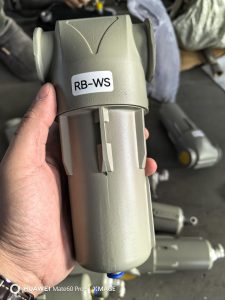
Many factory maintenance workers encounter this problem: even after they fully perform scheduled air compressor maintenance and install a brand-new oil separator, the machine still leaks oil rapidly and consumes far more lubricant. Replacing the filter repeatedly fails to fix the issue. This severe short-term oil leakage usually has nothing to do with the filter. It is difficult to detect and often wastes materials.
Typical issue:
Maintenance triggers rapid oil loss, and installing a new oil separator cannot stop leakage. Specifically, the screw air compressor at an electronics factory suffered severe oil leakage merely 300 operating hours after maintenance, as golden lubricant flowed continuously from the air tank drain. Although the maintenance team fitted a brand-new oil separator, the leakage still persisted. Consequently, frequent oil top-ups pushed maintenance costs sharply higher.
Engineers then launched an investigation and found that core parameters remained normal, including exhaust pressure, oil temperature and pressure difference. Meanwhile, the return oil line temperature was fine, and the return oil check valve worked properly. For this reason, they immediately eliminated three common culprits: a faulty oil separator core, overfilled oil and a blocked return line. It was not until they disassembled the oil-gas tank that they spotted a small crack on the internal baffle, which turned out to be the root cause.
Principle Explainer: How Deflector Centrifugal Pre-Separation Works
Oil-injected screw air compressors adopt a three-stage oil-gas separation system: centrifugal pre-separation, fine filtration via the oil separator element, and oil return through pipelines. To begin with, the deflector leverages centrifugal force to hurl large oil droplets onto the oil-gas tank’s inner wall. As a result, only a small volume of leftover oil mist passes through the oil separator element for fine filtration, thereby limiting oil consumption.
However, if the deflector cracks, pre-separation stops working entirely. In that case, massive heavy oil-gas directly strikes the oil separator element. Since the filter element bears an oil load far beyond its design capacity, even a brand-new premium oil separator element cannot fully trap the oil. Accordingly, excess oil escapes alongside compressed air and drains from the air tank, ultimately causing persistent abnormal oil carryover.
Ops Tips: Do Not Blindly Replace Oil Filters — Proper Troubleshooting Reduces Maintenance Costs
When an air compressor exhibits surging oil consumption or persistent oil leakage after servicing, blindly replacing filters will only push up material costs. In fact, equipment and installation faults — including a cracked deflector, reversed piping, clogged return lines and improper alignment — can all trigger severe short-term oil leaks. Since these easily overlooked hidden problems accelerate equipment wear, operators should carry out careful inspections for such issues during routine checks.
Recommended Consumables: Premium Three Filters + Well-Maintained Piping Deliver Durable, Stable Oil Control
Air compressors achieve low oil consumption and stable operation through dual safeguards: an intact, fault-free separation system and high-quality filter consumables. For this reason, our air compressor three-filter products adopt high-precision composite filter media alongside an optimized integrated sealing design. Not only do they feature low pressure loss, oil resistance, high-temperature resistance, superior filtration precision and long service life, but the filters also deliver efficient fine oil-gas separation, thereby helping enterprises cut long-term expenses on consumables, maintenance and lubricants.
Welcome everyone to visit our facotry and explore the possibility of cooperation
TEL:+86 19857000898
Contact email:xuhaitao@zjboling.cn
Address:No. 6, Chihuai Road, Kaihua, Quzhou City, Zhejiang Province,China