
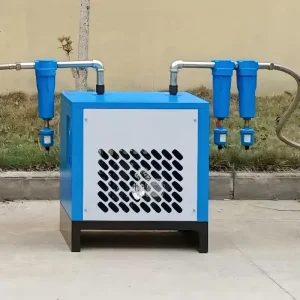
Stricter global environmental and energy-efficiency regulations make refrigerant selection a critical issue in the refrigeration industry. Each refrigerant offers distinct trade-offs in environmental performance, energy efficiency, and application fit. I will analyze the characteristics and applicable scenarios of several common refrigerants to help you better understand your selection and application decisions.
1.R22 — A traditional refrigerant being phased out
R22 – ODP 0.05, GWP 1700. Boasts mature technology and established support infrastructure, but depletes ozone and faces global phase-out. EU prohibited new equipment since 2015, US banned production/import since 2020. Currently only services existing systems in regions without bans (e.g., some developing countries); new installations cannot use R22.
2.R134A — An environmentally friendly refrigerant with a high GWP (Gross Power Content).
R134A – ODP 0, GWP 1430. Offers non-toxic, non-explosive, environmentally friendly operation with good heat exchange and low pressure, but suffers low cooling density and relatively high GWP. Regulatory status: EU bans new car models since 2021, US allows but restricts under EPA and shifts to low-GWP alternatives, China allows but encourages substitutes (e.g., R1234yf). Primary applications: refrigerators, small AC units, and auto AC (gradually replacing with R1234yf).
3.R407C — A transitional refrigerant compatible with R22
R407C – ODP 0, GWP 1770. Offers environmental friendliness, low operating pressure, and compatibility with some R22 systems. Drawbacks: non-azeotropic blend – requires full recharge after leakage, low cooling density, and poor heat exchange performance. No explicit global ban yet, but the EU, US, and China are gradually phasing down its use. Primary application: small-to-medium commercial AC and heat pumps (need regular maintenance).
4.R410A — The first choice for high-efficiency industrial refrigeration equipment
R410A – ODP 0, GWP 2100. Offers environmental friendliness, high energy density, excellent heat exchange performance, and preferred status in industrial refrigeration. Drawbacks: requires specialized equipment due to high system pressure, and carries relatively high GWP. Global use widespread (except some US industry restrictions), primarily in residential/commercial AC and heat pumps requiring high energy efficiency.
Welcome everyone to visit our facotry and explore the possibility of cooperation
TEL:+86 19857000898
Contact email:xuhaitao@zjboling.cn
Address:No. 6, Chihuai Road, Kaihua, Quzhou City, Zhejiang Province,China