
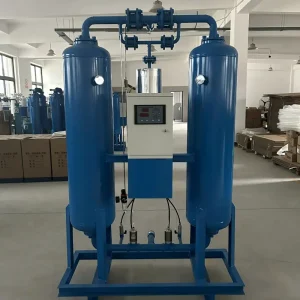
Whether it’s chemical manufacturing, electronics, laser cutting, or the food and beverage industry, a safe and reliable supply of industrial gases is crucial. In many areas, nitrogen is essential to production processes. Its main uses include preventing explosions and corrosion, as well as ensuring process and production safety.
Some companies and factories have found that after long-term use, nitrogen generators can produce gas with reduced purity. So, what factors actually affect nitrogen purity? Next, I’ll focus on the common issues that lead to substandard nitrogen purity and how to solve them.
(1) Nitrogen flow exceeds limit
Fault Symptoms
- Qualified nitrogen flowmeter reading exceeds the rated value on the nameplate.
- Impure purge flow exceeds the rated value; the unit cannot reach the target purity.
- Regeneration gas flow is too high.
- Wrong switching sequence.
Remedies
- Adjust the ball valve to restrict qualified nitrogen flow to its rated value.
- Adjust the ball valve to limit impure nitrogen flow to 2/3 of the rated value.
- Check the opening of the regeneration gas ball valve. The normal opening is 1/5.
- The nitrogen generator switching cycle is too short or too long. Set pressure equalization time to 2–3 seconds.
(2) Low compressed air inlet pressure
Fault Symptoms
- Nitrogen generator inlet pressure drops below 0.6 MPa.
- Blockage or faults in refrigerated dryer, adsorption dryer or filter cause low inlet pressure.
- Improper opening of inlet/outlet ball valves or shut-off valves.
Remedies
- Check the compressor discharge pressure and main air pipeline pressure gauge to verify whether pressure stays above 0.6 MPa.
- Check pressure before and after the refrigerated dryer, remove ice blockage, inspect abnormal exhaust of the adsorption dryer, and clear blockage in the outlet dust filter.
- Check and adjust the opening of inlet, outlet, regeneration and solenoid valve air-source ball valves to proper positions.
(3) Equipment malfunctions
Fault Symptoms
- Air pressure gauge failure.
- Pneumatic valve or solenoid valve failure; burnt coil or stuck valve core.
- PLC failure, burnt contacts; the PLC cannot supply power to solenoid valves.
- Molecular sieve sinking alarm; black powder sprays from the silencer.
Remedies
- Inspect the pressure gauge. Calibrate or replace it if faulty.
- Run jog tests and verify the switching indicators and movements of solenoid and pneumatic valves.
- Use indicator lights or a multimeter to check burnt PLC contacts. The PLC has spare contacts, so replace damaged contacts quickly.
- Loose molecular sieve causes powdering and black smoke, triggering the sinking alarm. Stop the machine immediately and contact the manufacturer for repair.
Welcome everyone to visit our facotry and explore the possibility of cooperation
TEL:+86 19857000898
Contact email:xuhaitao@zjboling.cn
Address:No. 6, Chihuai Road, Kaihua, Quzhou City, Zhejiang Province,China