
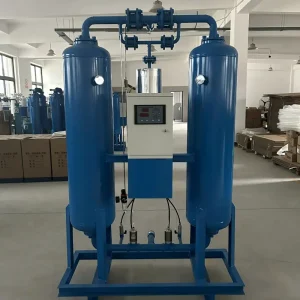
Nitrogen purity is critical to production. Poor-quality nitrogen can impair weld appearance, cause product oxidation and process faults, and create serious safety risks in chemical and fire protection applications.
Our previous article covered how nitrogen generator internal and auxiliary system mechanical faults cause low nitrogen purity, along with corresponding countermeasures. This article focuses on external factors: how ambient temperature, compressed air dew point (moisture) and residual oil affect nitrogen generator purity and performance.
01 Ambient Temperature
Nitrogen generators are designed to operate stably at 0–45°C. Operation outside this range leads to performance deterioration and higher failure rates.
When ambient temperature exceeds 45°C, the air compressor discharge temperature rises and overloads the refrigerated dryer, which may shut down on overheat. This worsens compressed air dew point and severely cuts nitrogen generator efficiency. At the same nitrogen purity, gas output can drop by over 20%; if output is kept constant, nitrogen purity will fall below design specs. Lab temperature tests also show that below -20°C, certain electrical components fail to start or malfunction, stopping the whole unit.
Solution:Optimize the machine room environment. Improve ventilation in summer and provide heating in winter to maintain a proper ambient temperature.
02 Compressed Air Dew Point (Moisture)
Compressed air moisture, measured by pressure dew point, directly affects carbon molecular sieves, so nitrogen generators demand high-quality inlet compressed air.
Field Cases
Case 1: A user’s air receiver tank had no automatic drain and was not drained manually. The dryer’s inlet and outlet three-stage filters also lacked regular draining. Excess moisture caused the downstream activated carbon filter to cake and block pipelines, lowering inlet pressure and resulting in poor nitrogen purity. The issue was fixed by installing drainers.
Case 2: A faulty water separator on the refrigerated dryer failed to remove condensed liquid water. Large volumes of liquid water entered the nitrogen generator, damaging two solenoid valves within a week. Liquid water corroded the angle seat valve piston seals, causing valve failure and shutting down the unit. Replacing the refrigerated dryer resolved the fault.
1. Carbon molecular sieves rely on surface micropores to adsorb oxygen. Excessive moisture shrinks micropores and causes surface powdering, blocking the pores. The sieve can no longer deliver the designed nitrogen flow and purity.
2. It is recommended to install an adsorption dryer before the nitrogen generator to lower air moisture and protect molecular sieves from heavy water and oil contamination. This can extend sieve service life by 3–5 years (subject to purity requirements).
03 Residual Oil in Compressed Air
1. Molecular sieves separate gas via pressure adsorption in surface micropores, but they are vulnerable to oil contamination, which is permanent and irreversible. Hence there are strict limits on oil content at the nitrogen generator inlet.
2. Oil coats the sieve’s micropores and blocks oxygen adsorption. Nitrogen output declines, or purity will degrade within 5 years even if flow stays unchanged.
Solutions:Maintain good ventilation and low temperature in the machine room; reduce residual oil in compressed air. Use refrigerated dryers, adsorption dryers, filters and activated carbon oil removers for upstream protection. Regular service of pre-treatment equipment preserves nitrogen generator performance and prolongs carbon molecular sieve life.
04 Summary
Ambient temperature, moisture and residual oil in compressed air are key external factors affecting nitrogen generator performance. Upstream purification equipment — refrigerated dryers, adsorption dryers and filters — has a direct impact on system operation. Choosing reliable, high-efficiency dryers is essential.
Many nitrogen generator suppliers do not manufacture compressed air pre-treatment equipment. When faults occur, it often leads to finger-pointing between nitrogen generator and dryer manufacturers.
Welcome everyone to visit our facotry and explore the possibility of cooperation
TEL:+86 19857000898
Contact email:xuhaitao@zjboling.cn
Address:No. 6, Chihuai Road, Kaihua, Quzhou City, Zhejiang Province,China