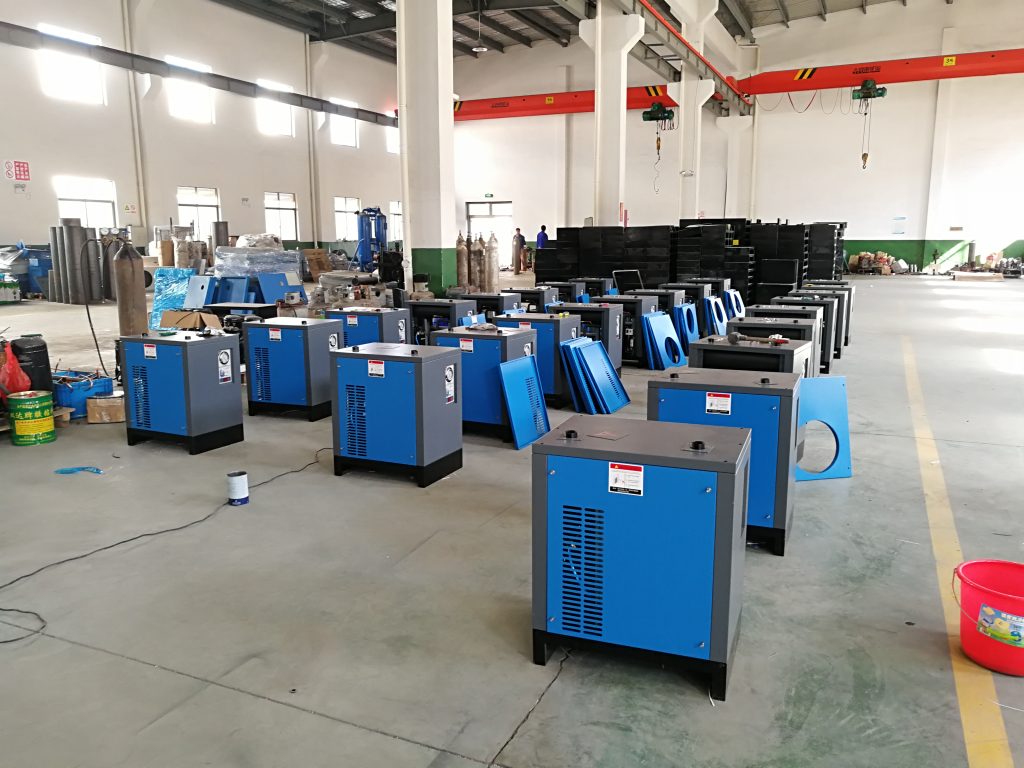
Core purpose and function analysis
1.Key applications of air compressors in the textile industry
●Power Drive and Automation:
The air compressor provides high-pressure gas power for equipment such as jet looms and air wrapping machines, driving the nozzle to spray air flow to complete the weft insertion action, replacing traditional shuttles and achieving high-speed and efficient production. For example, a jet loom uses compressed air to precisely feed the weft yarn into the fabric opening, improving fabric density and uniformity.
●Yarn processing and cleaning:
Air compressors are used for yarn cleaning, drying, humidification, and adjustment. They remove impurities and dust through high-pressure airflow, ensuring the cleanliness and flexibility of the yarn and laying the foundation for subsequent textile processes.
●Equipment maintenance and pneumatic control:
The air compressor drives pneumatic components (such as cylinders and valves) to achieve automated operation of textile machinery; At the same time, its high-pressure airflow can clean the dust inside the equipment and extend its service life.
2. The core function of air dryer
●Humidity control and quality assurance:
Air dryers use freezing or adsorption technology to remove moisture from compressed air, controlling the pressure dew point below 4 ℃ (some scenarios require -20 ℃) to avoid nozzle blockage, fabric pollution, or equipment corrosion caused by moisture condensation. For example, if a jet loom uses moist air, it will reduce the weft insertion accuracy and increase the defect rate.
●Oil and dust purification:
Combined with precision filters, the dryer can remove oil mist (oil content should be ≤ 0.1 mg/m ³) and dust (≤ 1 mg/m ³) from compressed air, preventing oil particles from contaminating textiles or adhering to mechanical components, and meeting food grade contact standards.
●Energy saving and stability improvement:
Drying machines reduce the corrosion of pipelines and equipment caused by moisture, thereby lowering maintenance costs; At the same time, avoid moisture affecting the physical properties of textile materials (such as fiber deformation and color difference), ensuring production continuity and product consistency.
3. Comprehensive advantages and industry trends
●Efficient and energy-saving:
Modern air compressors adopt permanent magnet frequency conversion and waste heat recovery technology, reducing energy consumption by more than 30%; The dryer optimizes dew point through intelligent control, reducing energy waste.
●Green production:
The combination of oil-free air compressor and high-efficiency dryer avoids lubricating oil pollution and meets environmental protection requirements, especially suitable for high-end textile and medical material production.
●Intelligence and customization:
IoT technology enables real-time monitoring of air compressors and dryers, adjusting air pressure and humidity as needed; Manufacturers provide customized solutions to meet different process requirements (such as chemical fiber drying, printing and dyeing penetration).
Example of typical application scenarios
●Jet loom weft insertion system:
The air compressor provides dry and oil-free high-pressure air, driving the nozzle to complete thousands of weft insertion actions per second, significantly improving weaving speed and accuracy.
●Drying and humidification of yarn:
The air compressor generates uniform airflow, regulates yarn humidity, and avoids breakage or elastic loss caused by environmental changes.
●Optimization of Printing and Dyeing Process:
Dry air accelerates the penetration of dyes into fibers and shortens the curing time of printed and dyed products through airflow drying technology, improving color uniformity.